

Long before Zeus was Hera's husband, he was married to MétisThe goddess of prudence and wisdom. Métis was known for her cunning, and for many years she was Zeus' advisor, helping him plan his victories against the Titans and secure his place as king of the gods.
Index
The Wedding of Zeus and Métis
When Zeus married Métis, he knew that she carried great power with her, but he was warned by a terrible prophecy: the child she would give birth to would be more powerful than him, capable of overthrowing him, just as he had done with his own father, Kronos. Fearing that this would happen, Zeus took a drastic decision.
While Métis was still carrying her daughter in her womb, Zeus tricked her and swallowed. In this way, he believed he would prevent the birth of the child who could threaten his throne. However, the power of Métis' wisdom could not be erased so easily. Inside Zeus, Métis remained alive, and the child, AthenaShe grew up in secret, nurtured by her mother's own wisdom.
The Birth of Athena: Daughter of Zeus and Métis
Months passed, and Zeus began to feel an unbearable headache. The pressure on his mind grew every day, until he couldn't stand it any longer. He called Hephaestus, the son he had with Hera, to help him. Hephaestus, obeying the order, raised his axe and with one firm blow split Zeus' head open.
From inside the mind of Zeus, Athena emerged - fully grown, fully armed, with a spear in her hands and a war cry on her lips. She was not only the daughter of Zeus; she carried within her the infinite wisdom of Métis, inheriting her mother's intelligence and prudence.
Athena, born in such an extraordinary way, immediately became the goddess of wisdom, strategic warfare and justice.
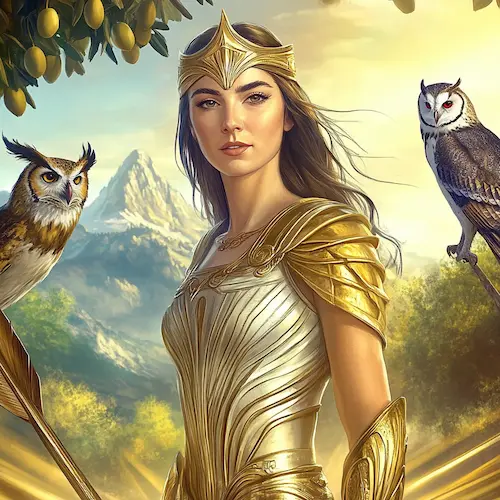
Athena's reflection:
"I was born from my father's mind, but I am also the fruit of my mother's wisdom. Métis lives in me, and every decision I make carries her prudence and cunning. My existence is a balance between the strength of Zeus and the sharp mind of Métis.
Pallas: Daughter of Triton and Companion of Athena
In a time immemorial, when the gods walked among men and the secrets of the sea were guarded by the sons of Poseidon, he was born Pallasdaughter of the mighty sea god Triton. Although her father ruled the depths of the ocean, Pallas had a different soul - she was not only attracted by the vastness of the waters, but also by the allure of battles and the strategies that governed the field of war.
Just like AthenaPallas loved the art of strategy. From an early age, she developed a taste for the sword and for the wisdom that came from cunning, not brute force. The gods, observing the two young women, soon realized that something united them. Pallas and Athena, with their daring spirits and sharp minds, became inseparable. Both were practically the same age, and this closeness led them to share more than a love of just war - they built a friendship that transcended Olympus and the battlefield.
Training and Friendship
On the vast plains of the gods, Athena and Pallas trained every day. The sound of clashing swords echoed through Olympus. The two competed, not to beat each other, but to improve themselves. Together, they mastered the use of weapons, but also the use of their minds, developing tactics that only warriors with a noble soul could create.
PallasPallas, with her intense nature, challenged Athena in a unique way, and Athena relished this rivalry. For her, Pallas was more than a companion in arms - she was her most faithful friend, someone with whom she could share her ideas, her love of justice and her desire to protect the mortal world.
The years passed, and as the two warriors became more and more skilled, their friendship grew. Together, they forged a bond that seemed unbreakable. Athena, with her prudence, often acted as a guide, but Pallas, with her fearless spirit, always reminded the goddess that courage and strength also had their value.

The Tragedy
But fate, always unpredictable, was preparing a tragic turn of events that neither of them could avoid. During one of their training sessions, on an apparently ordinary day, the two warriors were dueling. The sun was shining over the mountains of Olympus, and the sound of swords cut through the air. In a moment of carelessness, or perhaps a subtle intervention by the gods, Athena was distracted - they say it was Zeuswho interfered, fearing for his daughter's safety.
Athena's swift movement, which was supposed to be just another training blow, was too fast for Pallas to react. The blade sliced through the air, and before Athena knew it, Pallas fell to the ground, mortally wounded. Shock overtook the goddess of wisdom. She rushed to her friend's body in despair. Her eyes, which had always carried the gleam of reason and calculation, were now filled with grief.
"Pallas!" shouted Athena, kneeling down next to her companion. "This blow should never have been yours! This wasn't how our story was going to end..."
Mourning and the Promise of Athena
For days, Athena carried the weight of guilt, unable to accept that her own hand had taken the life of her dearest friend. In her mind, she relived the duel over and over again, searching for the exact moment when she could have changed the course of that tragedy.
It was then that the goddess, in her wisdom, decided that Pallas' memory would never be forgotten. To honor her friend, Athena adopted the name Pallas as part of her own identity, becoming known forever as Pallas Athena. With that, in every battle he fought, in every victory he won, Pallas would be by his side.
Athena's Reflection on Loss
"Your courage lives in me, Pallas. Your spirit, always agile, always fearless, will be my eternal companion. My every victory will also be yours, and in every decision I make, the memory of our friendship will guide my hand. May your name echo in every corner, Pallas, for I, Athena, swear that you will never be forgotten."
Athena and Arachne: The Challenge of Weaving
In ancient Lydia, there lived a young woman called ArachneShe was famous for her weaving skills. Her work was so detailed and perfect that people soon began to comment that she must have been taught by some goddess. But Arachne, proud of her talent, vehemently denied any divine connection.
- I, Arachne, never needed the gods to master my art. Everything I created was the result of my own effort and skill - she said proudly.
This pride reached the ears of AthenaThe goddess of wisdom and the arts was offended by the young woman's arrogance. Not because Arachne was talented, but because she disdained the gods and refused to acknowledge that even mortal gifts could be influenced by the gods.
Determined to confront Arachne, Athena came down from Olympus, disguised as an old woman. She went to Arachne and tried to advise her:
- Young woman, do you accept that no matter how talented you are, you must honor the gods for having given you the gift of weaving so perfectly? Wisdom lies in recognizing the origin of every gift, whether mortal or divine.
But Arachne, arrogant, laughed at the suggestion.
- If Athena thinks she's better than me, let her come here and prove it! I don't fear the goddess or her arts. I'll weave against her and we'll win a fair contest.
Hearing this, Athena revealed her true form. She accepted Arachne's challenge and, without further ado, the two began a weaving competition.
The Duel in the Art of Weaving
The two weavers set to work, and soon their skills were shining through every thread. Athena, being the goddess of the arts, wove a tapestry that showed the gods in all their splendor, portraying the divine conquests and justice of Olympus. Her work reflected the order and beauty of divine creation.
But Arachne, rebellious and daring, wove a tapestry that showed the mistakes and failings of the gods. She depicted Zeus and other gods in their treachery, showing how they often abused their power over mortals. Arachne's tapestry was perfect in technique, but disrespectful in content.
When she saw Arachne's work, Athena couldn't help but admire the young woman's skill. The tapestry was indeed impeccable. However, disrespect for the gods was something that the goddess of wisdom could not tolerate.

The Wrath of Athena and the Transformation of Arachne
Athena, furious at Arachne's insolence, destroyed her tapestry with a single blow from her spear. But her anger didn't stop there. She looked at Arachne with goddess eyes and said:
- Arachne, your talent is great, but your arrogance is greater. You didn't recognize the power of the gods and dared to mock us. May your skill remain, but may your pride condemn you.
And so, Athena transformed Arachne into a spiderShe was sentenced to weave forever. From that day on, Arachne and her descendants would weave their nets without rest, forever remembering the power of the gods and the consequences of pride.
Athena's reflection on Arachne
After Arachne's transformation, Athena reflected on her decision. She hadn't punished the young woman for her skill, but for her lack of humility. For Athena, wisdom lay not only in talent, but also in the ability to recognize one's limits and the reverence needed to maintain the balance between mortals and gods.
Athena's reflection:
"Talent is a gift, but pride blinds the heart. Arachne wove with perfection, but failed to understand that true art also requires respect. May her eternal web remind her that even the most brilliant gifts must be guided by wisdom."
Conclusion
The story of Athena and Arachne is a tale of the dangers of pride and the value of humility. Arachne was an extremely talented young woman, but her contempt for the gods and her arrogance led to her downfall. By turning Arachne into a spider, Athena not only punished the young woman, but left a lesson for everyone: talent is a gift, but without humility, it can lead to ruin.
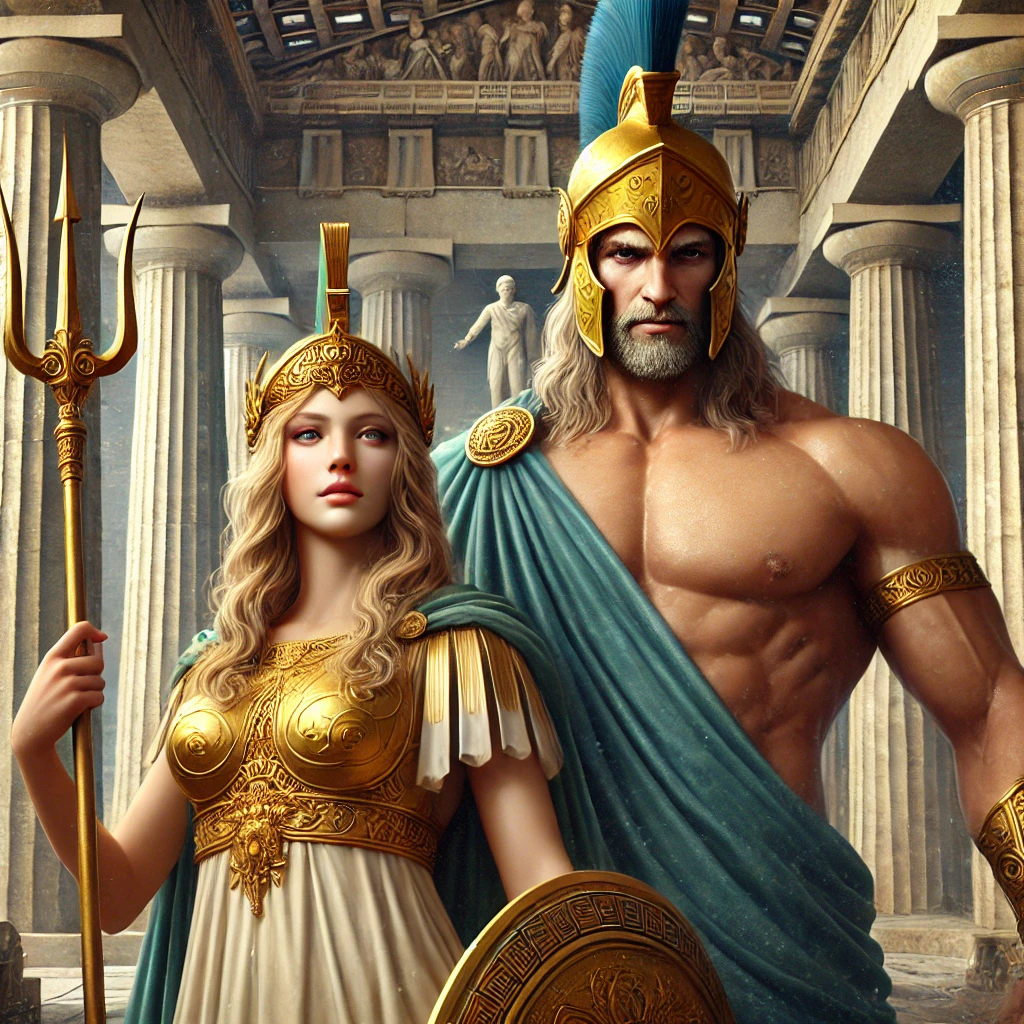
Athena and the Dispute for the Eternal City
Once upon a time, in the fertile and promising lands of Greece, a new city was being born. Its inhabitants, still unsure of who would protect them and guide them into the future, prayed to the gods for a patron. And their prayers reached Olympus, where two powerful gods answered their call.
Poseidonthe ruler of the seas, rose up in his majestic fury, determined to claim the city as his own. The ocean, always at his command, echoed his ambition. But AthenaThe goddess of wisdom and justice also looked upon the city with fondness. For her, this place was not just another land, but an opportunity to teach people the value of wisdom and peaceful progress.
Thus, the two gods descended from the heavens to earth, and the mortals were amazed. Poseidon, with his powerful trident, and Athena, with her serene gaze, expected the citizens to choose one of them to be the city's guardian. But how to decide between two such greats?
"Give us a gift," said one of the town elders, "and the one who offers the greatest gift will be the patron of our town."
Poseidon's Gift: The Brute Force of the Seas
Poseidon, always impulsive, was the first to act. He raised his shining trident and, with one blow to the ground, shook the earth. A great gush of salty water erupted from the ground like a fountain, spreading across the ground and forming a vast pool in the center of the city. The water sparkled under the sun, reflecting the indomitable power of the sea god.
The citizens were impressed. It was a grand demonstration, proof of Poseidon's strength. However, when the wisest among them approached the water, they realized that the fountain was salty And although it was beautiful, it was no good for drinking, irrigating the fields or sustaining their crops. Water would not bring life, but only ostentation.
Athena's Gift: The Wisdom Tree
Athena, with her calm gaze, watched the men examine Poseidon's gift. She knew that true power lay not in destructive force, but in what could be built. With a simple touch of her hand on the ground, she gave birth to a olive treeIts green leaves shining in the wind and its fruit ready to be picked.
"Here is my gift," said Athena. "The olive tree is a source of sustenance, peace and prosperity. Its fruit will provide oil for cooking and lighting your homes, its leaves will bring shade, and its wood can be used for building."
The citizens gathered around the tree and immediately understood the value of such a gift. It wasn't as grand as Poseidon's fountain, but it was useful, durable and essential. The olive tree represented the wisdom of the land, the lasting peace that nourishes future generations.
The Choice of Mortals
The inhabitants of the city looked at each other, and there was no doubt about who should be the patron of their city. Although Poseidon had demonstrated his power, it was Athena who offered something that would sustain their lives. With respect and reverence, the elders of the city turned to Athena.
"You will be our protectorAthena. Your olive tree will bring prosperity to our people, and your wisdom will guide us in the paths of justice."
Poseidon, furious with the choice, struck the ground with his trident one last time, creating cracks in the earth. But his anger could not change the mortals' decision. Since that day, the city has been known as Athensin honor of its new patron.
Athena's reflection
Athena, satisfied with the mortals' choice, looked at the city with affection. She knew that Poseidon's raw power might have been more impressive at first glance, but the true greatness lay in the wisdom and peace that the olive tree would bring for generations.
"Strength can create fountains and earthquakes, but it is wisdom that creates deep roots. May this city flourish under my protection, and may the men who live here always choose reason over fury."
Conclusion
And so Athena became the patron saint of Athens, and the city flourished under her protection. Its inhabitants learned that wisdom surpasses strength, and the olive tree became the symbol of peace and prosperity, a gift that would never wither, feeding and protecting men for many generations.
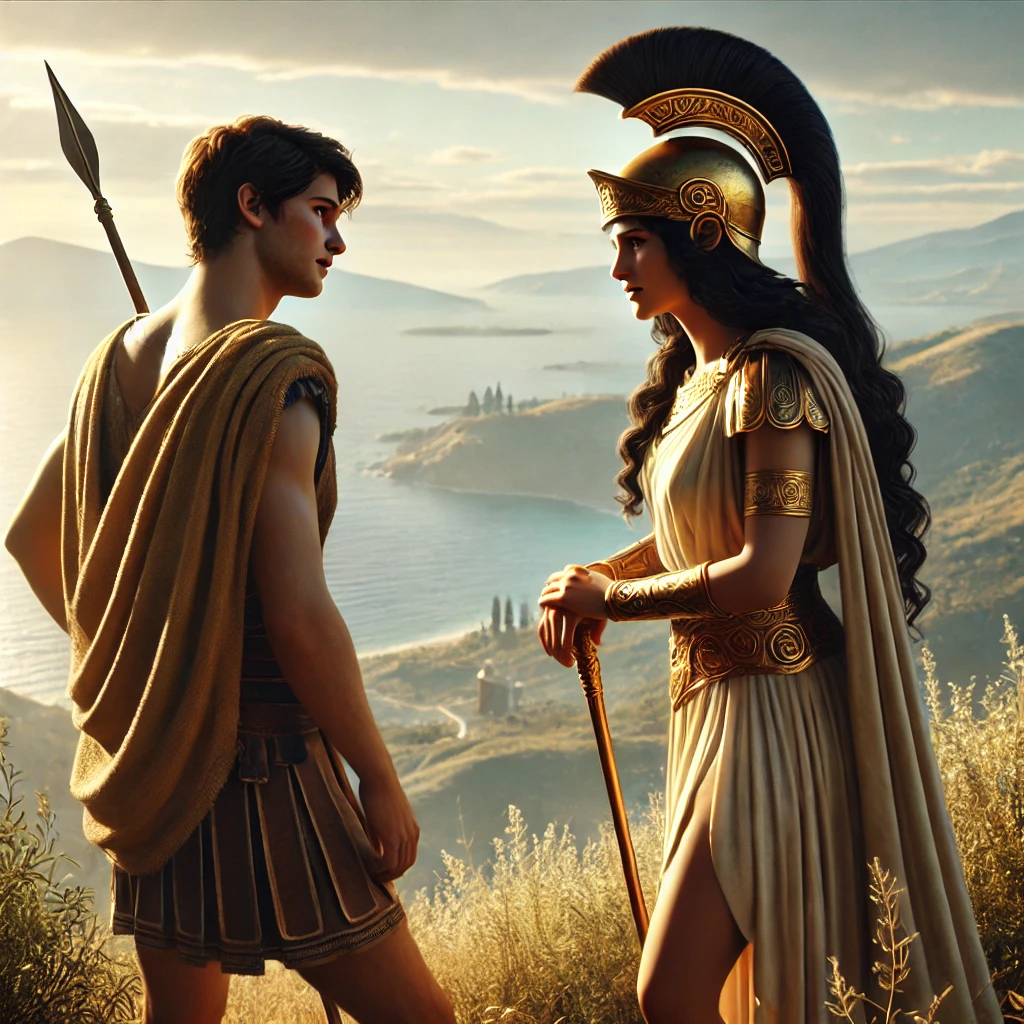
Athena and Odysseus: The Friendship Forged by Wisdom
Long before the Greek ships crossed the sea to Troy, a special friendship was born between the goddess Athena and a young prince from Ithaca called Odysseus. From an early age, Odysseus stood out not only for his skill as a warrior, but above all for his cunning e intelligenceThese qualities are rare among mortals and highly valued by Athena, the goddess of wisdom and strategy.
Athena observed with admiration how the young prince was able to solve complex problems with words and ingenious plans, instead of just resorting to brute force. Seeing in him a reflection of her own wisdom, Athena decided to protect and guide Odysseus, becoming his invisible guide in moments of doubt and crisis.
The First Test of Cunning
One of the first meetings between the two took place in Ithaca, when Odysseus, still a young man, was facing an internal conflict between using force to resolve disputes or opting for diplomacy. It was then that AthenaThe young man, disguised as a wise old man, appeared and counseled him:
- Athena in disguise: "Odysseus, true power lies not in the sword, but in the mind that knows when to use it and, more importantly, when to put it away."
Since then, Odysseus has followed Athena's advice in many of his decisions, becoming known not only for his bravery, but for his ability to think strategically.
The bond grows stronger
Over time, the friendship between Athena and Odysseus deepened. Athena, although a goddess, felt an unusual affinity for the cunning and resourceful mortal. For her, Odysseus was the perfect example of how wisdom and strategy could overcome brute force in any situation. And for Odysseus, Athena was more than a protective goddess - she was a friend, an invisible mentor who always guided him through the most critical moments.
Odysseus began to invoke the name of Athena in his prayers before every important decision. Over time, his name became synonymous with cunning, thanks to the goddess' constant influence.
The Road to Troy: The Promise of Athena
When the winds of war began to blow and the name of Troy began to be whispered among the Greek kings, Athena knew that Odysseus would be a key player in the conflict. She visited him once again, this time revealing herself in her divine form, with her shining armor and serene gaze.
- Athena: "Odysseus, difficult times are approaching. A great war is brewing, and in it, your mind will be as important as the strength of any army. I will be with you, guiding your steps, but it will be your cunning that will decide the fate of the Greeks."
Odysseus, always reverent towards his protector, promised that no matter what happened, he would follow Athena's advice, trusting in the goddess' wisdom to lead him to victory.
Athena and Ares: The War between Reason and Chaos
High up on Mount Olympus, where the gods watched over mortals in their deeds and misadventures, there was an eternal tension between two of Olympus' most powerful inhabitants: Athenathe goddess of wisdom and strategic warfare, and Aresthe god of violent and merciless war. Although they were both sons of Zeus, their views on the meaning of combat and power were as opposite as day and night.
To AthenaIn her view, war was a last resort, something that should only be waged when all other options have been exhausted. She valued the use of the mind, prudence and justice. She was known for being the protector of heroes who used both their wits and their swords.
Ares, on the other hand, was the god who delighted in carnage, in the chaos of the battlefield, where brute force and destruction reigned supreme. He moved through wars like a hurricane, feeding on blood and brutality without regard for the consequences.
Clash of Ideals
This difference of vision inevitably brought them into conflict, both on Olympus and among mortals. On many occasions, the two gods argued in the council of the gods, and Zeus, seeing the fury growing between his sons, would often remain silent, allowing the confrontation between them to reveal their own natures.
Once, during a meeting on Olympus, Ares, with his fierce countenance and his helmet always tilted towards battle, spoke openly about war.
- Ares: "War is the very essence of power. There is no glory without the blood of enemies spattered on the ground. Only brute force decides the fate of mortals."
Athenawith his calm posture and calculated gaze, replied:
- Athena: "Strength without purpose is the way of fools, Ares. True victory lies not in destroying, but in preserving. The war I wage is guided by justice, by a clear mind. There is no honor in butchery without reason."
The clash between the two gods was as old as the war between men itself. While Ares descended on Earth with the fury of a storm, encouraging men to fight senselessly, Athena guided them, teaching them to fight wisely, always seeking peace as the true prize of any conflict.
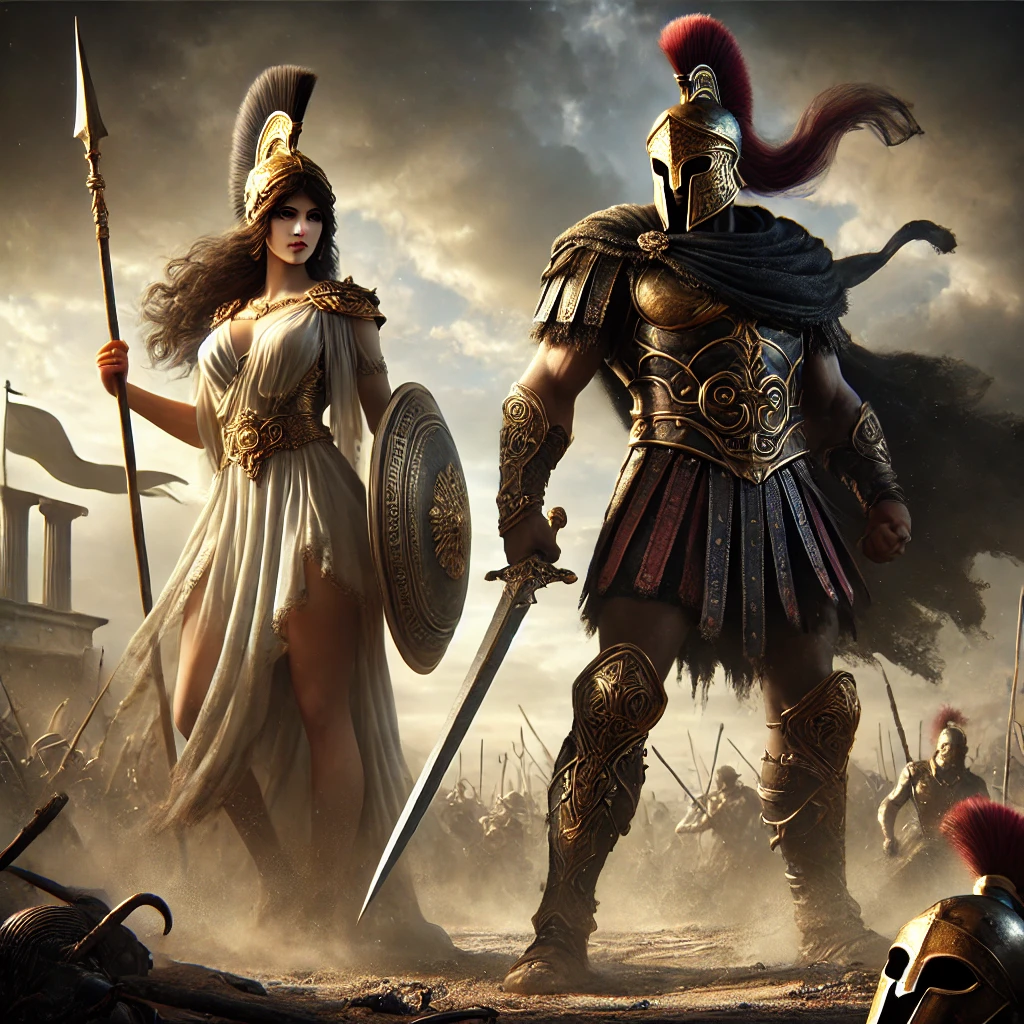
Athena and Ares on the Battlefield
In many battles, mortals found themselves involved in the eternal rivalry between Athena and Ares. When the armies met, you could feel the presence of the gods. Ares inspired the frenzy of battle, and his followers fought with blind ferocity. But Athena, with her strategy and calm, guided her heroes to victory, not by force, but by intelligence.
On several occasions, Athena overcame Ares on the battlefield, showing that the power of reason was superior to uncontrolled violence. In one of the greatest battles between the gods and mortals, Athena faced Ares directly. The god of war advanced with his sword raised, his eyes blazing with bloodlust.
AthenaWith the calmness of someone who knows that mind trumps strength, he dodged Ares' blow and, with a calculated move, disarmed his brother, proving once again that wisdom and strategy would always prevail over chaos.
Athena's reflection
"Strength without wisdom is destructive, but wisdom without strength is impotent. True power lies not in who can destroy, but in who knows when and how to protect. May Ares continue his fury, for there will always be those who prefer mind to muscle."
Conclusion
The rivalry between Athena and Ares remains an eternal reminder that there are different forms of power, and that wisdom and strategy are the strongest weapons a warrior can have. While Ares sowed chaos among men, Athena taught them to seek peace, fighting only when absolutely necessary and for a greater purpose.
Athena and the Apple of Discord: The Beginning of the Trojan War
Time passed and Athena consolidated her presence as the protector of the city that bore her name. Athens flourished, and the goddess proudly watched her people grow, always encouraging the use of wisdom and justice. But far away, in the mountains of Olympus, a new conflict was about to break out - a conflict that this time involved not only mortals, but also the gods.
It all started with a wedding. The gods and goddesses were invited to celebrate the union of Peleu e Tethystwo mortals who had won the favor of the gods. All the deities received the invitation, except one: Eristhe goddess of discord. Enraged by her exclusion, Eris decided to cause chaos among the guests.
She appeared silently in the middle of the banquet, and in her hands she carried a golden appleIt was as shiny as gold itself. Throwing it in the middle of the table, Eris simply saidFor the most beautiful". And then he disappeared into the shadows.
The Battle for Beauty
When the guests' eyes fell on the apple, three goddesses stood up: Ivythe queen of the gods, Aphroditethe goddess of love and beauty, and Athenathe goddess of wisdom and war. Each believed herself worthy of the prize, and none was willing to give in.
The tension grew, and soon the dispute between the three goddesses became the center of the party. The other gods watched cautiously, afraid to get involved. Finally, all eyes turned to ZeusI waited for him to resolve the impasse.
But Zeus, knowing that any choice he made would pit him against one of the goddesses, decided that he shouldn't be the judge of such a delicate matter.
- Let a mortal decide, - Zeus said. - An impartial man will choose which of you deserves the apple of discord.
And so the fate of the trial fell into the hands of a young Trojan prince called Pariswho lived in the hills, far from Olympus and its divine dramas.
The Trial of Paris
Paris, the prince of Troy, was brought to Olympus, where the three goddesses stood before him. Each one, eager to win, offered the prince a gift in an attempt to win him over.
IvyThe powerful queen of heaven promised Paris power over all the kingdoms of the earth. He would be the strongest king and would have dominion over peoples and nations.
Aphroditewith his radiant beauty, offered him something more tempting: the love of the most beautiful woman in the world, Helen of Spartawife of King Menelaus.
AthenaFinally, he looked at Paris with his wise eyes and said:
- If you choose me, Paris, I will give you victory in battle and I will guide you wisely. No enemy will be able to defeat you, and you will be known for your intelligence and cunning.
The Trojan prince thought, but it was desire that spoke louder. He chose AphroditeHe was seduced by the promise of Helen, the most beautiful woman in the world. With this choice, Paris sealed the fate of his city and the whole of Greece.
The Wrath of Athena and the Beginning of the Trojan War
Athena, rejected, was furious at Paris' decision. The goddess' pride had been wounded, and she knew that her wisdom had been forfeited for Aphrodite's simple beauty. With this act, Troy became the enemy of the goddess of war and justice.
Soon after the trial, Paris fled with Helen to Troy, which infuriated Menelaus, the king of Sparta. Along with his brother, AgamemnonHe gathered all the kings of Greece to launch a war against Troy and bring Helen back.
Athena, still offended, decided to support the Greeks in the war. She allied herself with the Greek heroes, guiding them with her wisdom and protecting them in battle. Among the warriors, OdysseusOdysseus, the king of Ithaca, was one of those who won her favor the most. Athena knew that Odysseus, with his cunning and sharp mind, would be essential to the Greeks' victory.
Athena and the Trojan Horse
The war was long and devastating, but in the end, it was Athena's wisdom that turned the tide. Together with Odysseus, the goddess devised the plan for the Trojan Horse. Athena whispered the idea in his ear: build a gigantic wooden horse, the symbol of victory, and leave it as a gift for the Trojans. Inside the horse, the best Greek warriors would hide, ready to open the city gates when night fell.
Athena's plan worked perfectly. The Trojans, believing that the Greeks had left and that the horse was a peace offering, brought the huge gift inside their walls. When the city was asleep, the Greek warriors emerged from inside the horse, opened the gates and, with that, Troy was destroyed.
Athena's reflection
"Beauty may win hearts, but it is wisdom that wins battles. Troy did not fall by the swords of men, but by the minds of those who knew how to use reason as their greatest weapon. Paris, by choosing passion over prudence, brought about the end of his city."
Conclusion: Athena's role in the Trojan War
Thus, Athena played a crucial role in the fall of Troy, not by force, but by strategy. Her anger, provoked by the rejection of Paris, guided the Greeks to victory, and the city of Troy became an eternal reminder of the power of wisdom over fleeting beauty.
Orestes: The Burden of Vengeance
Orestes was the king's son Agamemnonone of the great Greek heroes of the Trojan War, and his wife Clitemnestra. The story of Orestes begins with a terrible act committed by his father. During the Trojan War, Agamemnon, seeking to win the favor of the gods so that the winds would help him sail, sacrificed his own daughter, IphigeniaIphigenia was killed on an altar to the goddess Artemis. This horrible act filled Clytemnestra, Iphigenia's mother, with hatred and a thirst for revenge.
When Agamemnon returned triumphantly from Troy, Clytemnestra, with the help of her lover EgistoShe murdered her husband in their own home in revenge for the death of their daughter. This event threw the house of Orestes into a cycle of blood and revenge.
Orestes, still very young at the time, was sent away for protection, but the desire to avenge his father's death grew in him over the years. When he reached adulthood, he was ordered by the god Apollo to return and avenge Agamemnon by killing his own mother, Clytemnestra, and Aegisthus, her lover.
That was the burden Orestes carried - killing his own mother to honor his father's legacy and fulfill the divine order.
The Murder of Clytemnestra
Orestes, with a heavy heart, returned to the city of Mycenae and, guided by his determination to follow the destiny imposed on him by the gods, killed Clytemnestra and Aegisthus. But in committing this act, he could not escape the consequences. The ErinyesThe spirits of vengeance pursued him relentlessly, for he had committed the greatest of crimes - the matricide.
The Erinyes didn't care that Clytemnestra had killed Agamemnon. For them, Orestes' act was a crime against the natural order of things, and they demanded revenge. Overcome by guilt and tormented by the avenging spirits, Orestes fled, looking for a way to escape the fate that seemed inevitable.
The Trial of Orestes: Athena as Judge
Eventually, Orestes found himself in the court of the gods, where he would be tried for his crime. But this time, instead of a trial governed solely by the Erinyes and revenge, it was decided that Athena should preside over the case. As the goddess of wisdom and justice, she was the only one who could balance the forces of revenge and forgiveness.
In court, the Erinyes demanded that Orestes be punished for his mother's death, arguing that no crime could be greater than matricide. They called for the ruthless justice of the cycle of blood, where bloodshed must be paid for with more blood.
On the other hand, Orestes, with the support of ApolloHe argued that he had acted under divine orders and that his mother had killed his father, Agamemnon, in an act of betrayal and revenge. He did not wish to have committed the murder, but he did it out of duty and to follow divine justice, placing himself under the judgment of the gods.
Athena listened to both sides, carefully weighing up the arguments. She understood both the power of the Erinyes and Orestes' dilemma. He had acted in the name of justice, but the crime he had committed could not be ignored.
Athena's Decision: The End of the Cycle of Vengeance
In the end, Athena made a bold decision. Instead of allowing the cycle of revenge to continue, she voted to acquit Orestes. Athena decided that instead of punishing Orestes with more bloodshed, he should be forgiven, breaking the cycle of revenge that had plagued her family for generations.
She said:
- The time for revenge is over. Justice cannot be based solely on bloodshed. Orestes, you committed a crime, but you did it under divine orders, and your suffering has been great enough. May the Erinyes understand that justice must evolve, and that forgiveness can be as powerful as punishment.
With this decision, Athena not only freed Orestes, but also transformed the Erinyes themselves. They ceased to be spirits of vengeance and became Eumenidesbenevolent goddesses of justice who would now bring balance and harmony, instead of perpetuating the cycle of hatred and blood.
Athena's reflection
"True justice is not blind to pain or suffering. It cannot be based solely on revenge, for that only leads to more tragedy. Orestes has suffered enough. May this decision mark the beginning of a new era, where wisdom and balance guide our steps, not implacable wrath."
Conclusion: The Trial of Orestes
Thus, thanks to Athena's wisdom, the cycle of blood and revenge that had enveloped the house of Orestes was finally broken. Justice triumphed not through force or fear, but through understanding and the need to break with the old customs of revenge. Orestes was acquitted, and Athena's justice marked the beginning of a new kind of order, where balance and wisdom would prevail over the blind desire for punishment.
Athena and Niké: The Goddess of Wisdom and the Goddess of Victory
In Greek mythology, Niké is the personification of victory, both in battles and competitions. She is often depicted as a winged figure holding a laurel wreath, ready to crown the victors. Niké not only symbolizes military victory, but also excellence in competitions and overcoming challenges through skill and merit.
Niké is the daughter of Pallas (not to be confused with Athena's friend Pallas) and Styx and is part of a group of minor gods who supported Zeus during the Titanomachy, the great war between the Olympian gods and the Titans. As a reward for her loyalty, Zeus granted Niké a prominent place at his side.
The relationship between Athena and Niké
The connection between Athena e Niké is very symbolic. Athena, as the goddess of strategic warfare and wisdom, represents planning, justice and the measured use of force. Niké, on the other hand, is the personification of victory - the end result of strategy and bravery.
Athena is often depicted with Niké in your hand or by her side, highlighting the fact that victory (Niké) is linked to wisdom and strategy (Athena). The most famous statue illustrating this union is the Athena PartenosThe sculpture by Phidias, in which Athena holds Niké in one of her hands, suggests that victory is achieved through strategy and justice, not just brute force.
Niké: The Eternal Companion of Righteous Victory
Niké is the personification of the victory that Athena always carriedShe was a constant ally. In all her deeds - whether supporting heroes like Odysseus or leading battles - Niké's presence symbolized that success and conquest were inevitable for those who fought wisely and justly. Their partnership conveyed the message that true victory, the kind that deserves to be celebrated, comes through a clear mind and well-applied justice.
Athena and Niké at the Parthenon
The most famous example of this relationship can be found in the Parthenonthe great temple of Athena in Athens. In the portico of the temple, Athena is depicted holding Nikésymbolizing the city's triumph over its enemies. This image strengthens the bond between the two goddesses, demonstrating that Athena's victory over her enemies - whether in physical battles or in cultural and intellectual competitions - has always been guided by Athena's wisdom and accompanied by the certainty of victory, symbolized by Niké.
Athena's reflection on Niké
"Niké, you are proof that victory belongs not only to the strong, but to those who use their mind and heart to guide their steps. May our union be eternal, for victory without wisdom is empty, and wisdom without victory lacks purpose."
Conclusion: Niké as a Symbol of Victory through Wisdom
The relationship between Athena and Niké goes beyond simple support for military victory. She represents the Greek ideal of arete (excellence), which could only be achieved through the harmonious use of mind and strength. For Athena, having Niké by her side was not just a symbol of power, but of intelligent leadership and achievements that inspired mortals to fight for justice and wisdom.
Athena and the Culture of Athens: The Goddess Who Defined a City
Athena, as the patroness of Athens, profoundly shaped the city's cultural and political identity. The city honored the goddess not only as its protector in times of war, but as the embodiment of the values the Athenians held most dear: wisdom, justice and strategy. The Parthenon, the great temple of Athena in the heart of Athens, was not just a place of worship, but a symbol of the city's power and prestige.
Athens: The "Chosen One" by the Goddess
The myth of dispute between Athena and Poseidon the city reinforced the idea that Athens was a special city, favored by the goddess of wisdom. This generated a feeling of cultural superiority among the Athenians. They saw Athena's choice as divine recognition that their city was the wisest and most prosperous in all of Greece. A olive treeA symbol of peace and wisdom, it has become an emblem of the city and its advanced civilization.
The Athenians were proud of their connection to Athena and often considered themselves the direct heirs of her wisdom and justice. This led Athens to become a center of culture, art, philosophy and politics, profoundly influencing the Greek world and beyond.
Athenian Superiority and the Rise of Vanity
Over time, this pride turned into vanity. The Athenians came to see themselves as culturally superior to other Greek city-states such as Sparta, Corinth and Thebes. Athens was the birthplace of great philosophers, such as Socrates and Platoand playwrights such as Sophocles and Euripides. This created a sense that the Athenians were the true representatives of Greek civilization, while other city-states were seen as inferior.
The Opposition to Sparta
This vanity was especially reflected in the rivalry between Athens and Spartawhich culminated in the Peloponnesian War. While the Spartans were known for their military strength, the Athenians prided themselves on their culture and intelligence. Athena, as the goddess of wisdom and strategic warfare, was a symbol of the perfect balance between power and reason. This was in direct contrast to the more brutal and direct approach of Sparta, which revered Ares as one of its gods of war.
The Athenians saw themselves as defenders of democracy, culture and reason - qualities associated with Athena - while the Spartans were seen as militaristic barbarians. This feeling of cultural superiority was both a motivating force and a point of weakness for Athens, which, despite its greatness, ended up losing the Peloponnesian War.
The Dark Side of Athenian Vanity
However, the Athenians' vanity and excessive pride, often fueled by their association with Athena, also led them to make strategic mistakes, such as the disastrous expedition to Sicily during the Peloponnesian War. This event, motivated by ambition and arrogance, weakened Athens and led to the decline of its supremacy over the Greek world.
This connection with Athena, while initially positive for inspiring Athens' intellectual and artistic growth, also contributed to the Athenians underestimating their opponents and believing that cultural superiority would make them invincible. Athena, the goddess of strategy, may have seen the arrogance of mortals as a fatal mistake, since true wisdom involves recognizing both one's own strengths and weaknesses.
Conclusion: Athena and the Vanity of the Athenians
Although Athena was an inspirational figure for the cultural and intellectual development of Athens, devotion to her image as the goddess of wisdom ended up contributing to a certain vanity among the Athenians. They came to see themselves as the goddess' favorites, which generated both great advances and the arrogance that led the city to some of its worst defeats.
Athena's influence over Athens was therefore a symbol of the balance between wisdom and power, but also a warning that the wisdom without humility can turn into vanity and, eventually, ruin.
Athena in the Modern World
Athena, as a symbol of wisdom, strategy and justice, transcended Greek mythology and became a lasting cultural icon. His image is used in various areas, such as:
- Legal systemsAthena is often represented as the goddess of justice, and her characteristics are embodied in court statues, where she represents impartiality and the search for a balance between justice and punishment.
- Education and WisdomAthena is also a symbol of wisdom in educational institutions, associated with learning, knowledge and intellectual development. She inspires not only the search for knowledge, but the ethical use of that knowledge, something fundamental in our society.
- Pop CultureAthena is referenced in films, series and video games as an archetype of intelligent and strategic leadership. The idea of a goddess who values reason, diplomacy and strategy still inspires contemporary characters and stories.
Music Inspired by Greek Mythology
In musical terms, Greek mythology, including Athena, served as inspiration for a number of epic compositions. A prominent example is the epic songs from movie sagas and game series that deal with mythological themes, such as the soundtrack to the "God of War" - famous for exploring the Greek pantheon and, in particular, the interaction between mortals and the gods. Athena plays a central role in some of the most epic tracks, which evoke a mixture of suspense and grandeur.
These soundtracks use elements of orchestral music to evoke emotions ranging from intellectual reflection to the glory of battle. The music that accompanies these moments has the power to capture the essence of the goddess of wisdom and her influence on events.
What's more, classical and modern composers created works based on Greek mythology. A famous example is the opera "Les Troyens" (The Trojans), by Hector BerliozAlthough it focuses on the Trojan War, it is set against the backdrop of the wisdom and justice of divine decisions. The presence of Athena and other gods influences the course of the epic battles.
Jorge Rivera-Herrans and "Epic: The Troy Saga"
Jorge Rivera-Herrans is the creator of an epic musical called "Epic: The Troy Saga", which revisits the myths of the Trojan War with an innovative and modern approach, using a mix of epic music with exciting modern rhythms. The work is divided into different parts, covering the history of the heroes, the gods and the war, all with an approach that brings Greek mythology closer to contemporary audiences.
One of the most striking parts of the project is how the narrative connects with the themes of the mythologybringing to light the importance of figures such as Athena and its influence on war and strategy. The music captures the grandeur and tension of the myths, and the figure of Athena, even if indirectly, is felt in the unfolding of the Trojan War, since she is one of the most influential goddesses in this context.
The work of Rivera-Herrans combines epic music with a contemporary style of storytelling, addressing both the glory of the heroes and the moral dilemmas and divine influences that shape their destinies. Athena, as the goddess of wisdom and strategic warfare, is present as part of the divine atmosphere that permeates the war and the heroes' decisions.
Cultural Reflection: The Relevance of Athena Today
Nowadays, Athena's influence can also be seen as an icon of the female empowerment. She symbolizes a form of power that is based not only on physical strength, but on intelligence, emotional balance and fair leadership. Her image of an independent, wise and warrior goddess has been used as an archetype of feminine strength in many contemporary movements.
Athena remains a timeless symbolIt has inspired everything from governments and institutions to popular culture, where Greek mythology still serves as a reference for narratives about wisdom, strategy and justice.

I'm passionate about magic and spirituality, always looking for new knowledge about rituals, energies and the mystical universe. Here, I share magical practices and spiritual tips for those who want to connect more deeply with themselves and the world around them, all in a light and accessible way.